Mental health conditions constitute a leading cause of disability worldwide, with the World Health Organization (WHO) estimating a 15% increase in the burden of mental disorders in Africa over the last decade . Conventional epidemiological models often focus on biomedical and proximate psychosocial risk factors. However, this lens fails to capture the foundational role of the political environment. The political determinants of health are defined as the systematic processes of structuring relationships, distributing resources, and administering power, which ultimately manifest as health inequities . In the African context, these determinants are not abstract; they are the lived realities of historical trauma, economic marginalisation, and political exclusion that directly sculpt the population's psychological landscape.
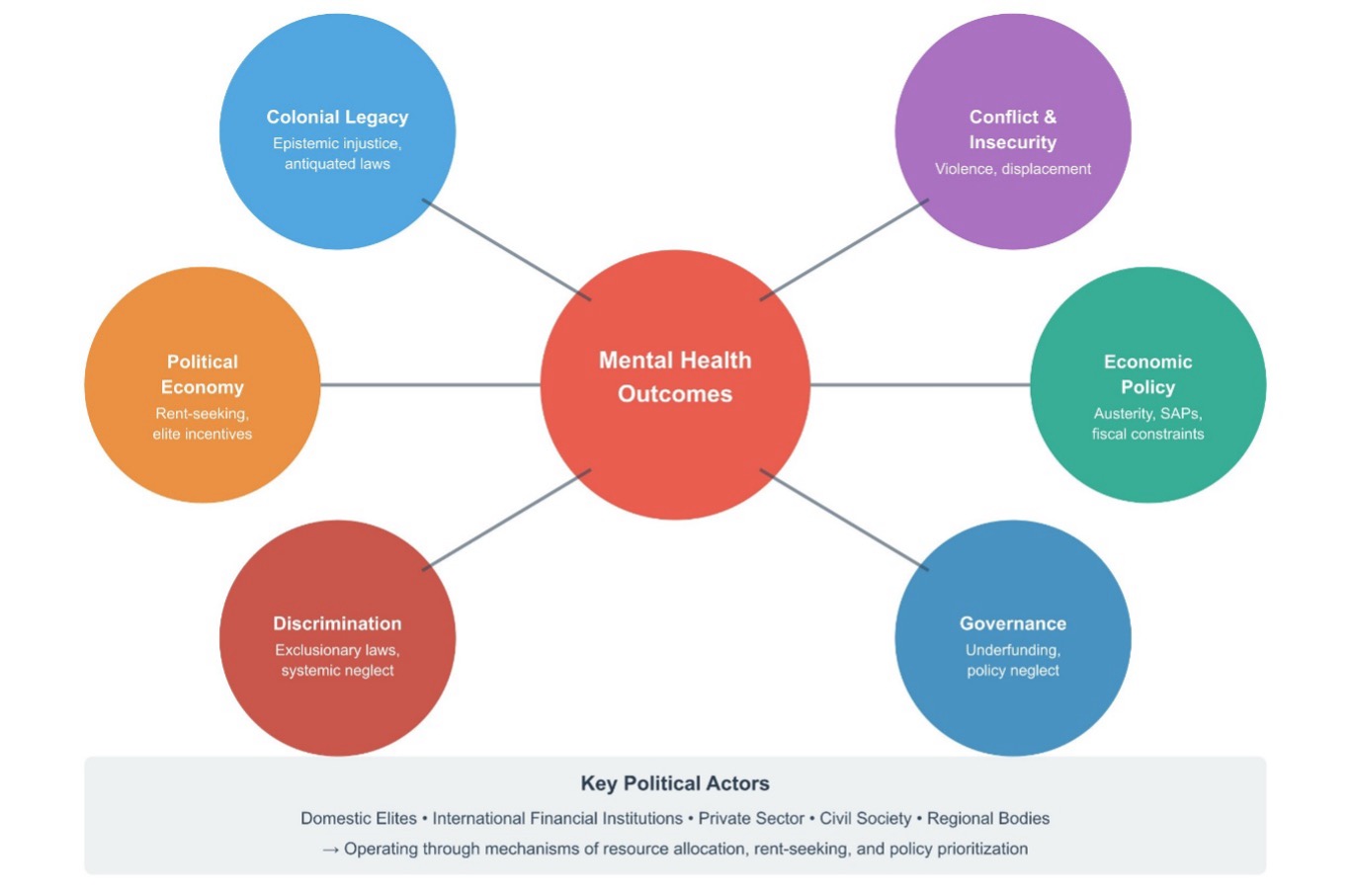
The Colonial Legacy and Epistemic InjusticeThe contemporary mental health infrastructure and discourse in Africa are indelibly marked by colonialism. Colonial psychiatry was primarily a tool of social control, pathologizing resistance and enforcing racist ideologies . This history has bred a deep and enduring mistrust of formal mental health systems. Furthermore, it entrenched a form of epistemic injustice, systematically devaluing indigenous, community-based understandings of psychosocial wellbeing and healing practices . Post-independence, many nations inherited legal frameworks — such as antiquated mental health acts — that emphasise custodial care over rights-based community rehabilitation, perpetuating stigma and human rights abuses . The political failure to decolonise mental health policy and integrate validated indigenous knowledge systems represents an ongoing barrier to care-seeking and effective service delivery.
Conflict, Forced Displacement, and Chronic InsecurityAfrica bears a disproportionate burden of conflict and terrorist violence, from the Sahel to the Horn of Africa and the Great Lakes region. The mental health consequences are catastrophic. Exposure to violence, loss, and forced displacement are potent risk factors for depression, anxiety, post-traumatic stress disorder (PTSD), and profound, intergenerational grief . Political decisions that fuel corruption, ethnic marginalisation, and state violence are direct etiological agents of this trauma. Moreover, chronic insecurity destroys social fabric, dismantles livelihoods, and overwhelms any fragile existing health services, creating a cyclical relationship between political instability and population-level psychological distress.
The Political Economy of Mental Health NeglectChronic underfunding of mental health necessitates an examination of the political economy shaping resource allocation. The neglect of mental health is not simply an oversight; rather, it stems from intentional political strategies employed by influential actors within systems of power and patronage. Domestic political elites face asymmetric incentives, as mental health services offer limited electoral returns compared to highly visible infrastructure projects. In clientelistic political systems common in Africa, where political survival depends on delivering material benefits to key constituencies, investment in mental health yields little political advantage . Individuals with severe mental illness are often politically marginalized, lacking organized advocacy groups and concentrated voting power.
International financial institutions (IFIs), including the World Bank and IMF, exert considerable influence through loan conditionalities and technical guidance. While IFIs publicly commit to strengthening health systems, their fiscal consolidation programs often restrict public spending on non-communicable diseases and mental health . Private sector actors similarly lack commercial incentives to invest in mental health in low-income African contexts, as markets for psychotropic medications remain limited and unprofitable.
Even when mental health budgets are allocated, rent-seeking behaviours frequently divert resources away from intended services. The Life Esidimeni tragedy in South Africa, where 144 psychiatric patients died after being transferred to unlicensed facilities, illustrates how political expediency and cost-cutting measures can lead to preventable deaths . This case demonstrates that resource capture occurs not only through overt corruption but also through politically motivated austerity measures that disproptionately affect vulnerable populations. Furthermore, illicit financial flows and tax avoidance by multinational corporations deprive health services of significant funding .
Political decisions to priotize debt servicing to national creditors over social sector investment further constrain fiscal space for health. This interacting political forces collectively shape mental health inequities across the continent.
Economic Policy, Austerity, and Social Determinants
Macroeconomic policies, often dictated by international financial institutions or domestic elite interests, are profound political determinants. Structural adjustment programmes (SAPs) of the late 20th century decimated public health spending across the continent, crippling the development of mental health services . The enduring legacy is a treatment gap exceeding 90% for severe mental disorders in many countries . Furthermore, austerity measures, regressive taxation, and illicit financial flows limit state capacity to invest in the social determinants of mental health: quality education, social protection, food security, and decent work. Unemployment, especially among youth, and pervasive economic inequality are powerful drivers of hopelessness, anxiety, and substance misuse . The substance use crisis among young people in countries like Sierra Leone exemplifies how economic marginalisation and limited opportunities translate directly into mental health and addiction challenges .
Discrimination, Human Rights, and Exclusionary LawsPolitical and legal frameworks that institutionalise discrimination have severe mental health repercussions. Discriminatory laws against LGBTQ+ individuals are associated with significantly higher rates of depression, suicidality, and internalised stigma among sexual minorities . Similarly, the political disenfranchisement and systemic neglect of people with disabilities, ethnic minorities, and refugees compound psychological distress. Gender-based violence, often inadequately addressed due to weak legal frameworks and patriarchal norms, is a major cause of trauma and mental ill-health among women and girls . When the state, through action or inaction, sanctions discrimination, it becomes a direct determinant of poor mental health.
Governance and Health System ArchitectureThe absolute neglect of mental health within national health policies and budgets is a political choice. The WHO Mental Health Atlas consistently reveals that the African region has the lowest per capita spending on mental health and the fewest mental health professionals globally . Mental health remains siloed within centralised, tertiary institutions, failing to be integrated into primary healthcare — a policy failure of prioritisation. Political leadership that views mental health as a peripheral concern, rather than a core component of universal health coverage (UHC), ensures the perpetuation of this crisis. The lack of meaningful participation of people with lived experience in policy-making further entrenches this marginalisation. The diverse experience of African countries illustrate how political determinants operate accross legal, fiscal, and governance domain (Table 1).
Table 1: Summary of Country Case Examples and Political Determinants| Country | Political Determinant | Policy Intervention | Outcome / Status | Key Lesson |
|---|---|---|---|---|
| Ghana | Colonial-era legislation perpetuating human rights violations | Mental Health Act 2012: rights-based framework, community care mandate | Implementation challenged by resource constraints and limited oversight capacity | Legislative reform requires sustained political commitment and adequate funding |
| Ethiopia | Severe workforce shortage and geographic inaccessibility | mhGAP task-shifting to non-specialists in primary care | Expanded access but <1% health budget; vulnerable to donor dependency | Innovative models require domestic budgetary protection from donor fluctuations |
| South Africa | Chronic underfunding despite progressive policies; rent-seeking and corruption | Mental health policies on paper without implementation; cost-cutting transfers | Life Esidimeni tragedy (144 deaths); continued institutionalisation | Political will must translate to budgets and accountability mechanisms |
| Rwanda | Post-genocide mass psychological trauma; inadequate psychosocial infrastructure | Integration into reconciliation, justice, and poverty reduction frameworks | Highest mental health worker ratio in sub-Saharan Africa; ongoing challenges | Framing mental health as essential to national development mobilises resources |
| Kenya | Limited civil society space; weak advocacy influence; donor dependency | Civil society advocacy for Mental Health Amendment Bill; peer support programmes | Bill languishing in parliament; services remain donor-dependent | Civil society requires protected space, sustainable funding, and genuine inclusion |
The Imperative for a Political Solution
Ignoring these political determinants has grave consequences. It leads to ineffective interventions that treat symptoms while ignoring root causes. It perpetuates a massive economic burden through lost productivity, estimated to cost the global economy $16 trillion by 2030, with Africa facing a disproportionate share due to its youthful population . Crucially, poor mental health undermines every sustainable development goal (SDG), from poverty reduction to education, peace, and justice. Addressing this requires a paradigm shift from a purely clinical to a political-economy approach.
-
Adopt a Rights-Based Framework
Governments must repeal discriminatory laws and align mental health legislation with the UN Convention on the Rights of Persons with Disabilities (CRPD), moving from coercion to supported decision-making . Ghana's Mental Health Act of 2012 represents one of the most rights-based mental health legislations on the continent, explicitly prohibiting involuntary admission except under stringent safeguards and establishing a Mental Health Authority to protect patient rights . However, implementation remains challenged by resource constraints and limited capacity for oversight, illustrating that legislative reform must be coupled with sustained political commitment and adequate funding. Conversely, many countries still operate under colonial-era mental health laws — several Anglophone African nations continue to use Mental Treatment Acts inherited from British colonial administration, which prioritise institutional confinement and grant broad powers for involuntary detention with minimal judicial oversight .
-
Increase Political Commitment and Financing
Domestic health budgets must ring-fence funding for mental health, targeting integration into primary care and community-based services. Ethiopia's Mental Health Strategy demonstrates the potential of political commitment despite limited resources . By 2014, a total of 244 health centers had completed mhGAP training, and by 2020, 5,000 urban Health Extension Workers participated in refresher training that includes mental health content . However, mental health receives less than 1% of the national health budget in Ethiopia, and services remain heavily dependent on donor funding. South Africa, despite being an upper-middle-income country with greater resources, has struggled with political prioritisation — chronic underfunding and poor implementation have resulted in continued institutionalisation and human rights violations in psychiatric facilities .
-
Mainstream Mental Health in All Policies
Mental health impact assessments should be required for economic, social, and security policies. Building social safety nets, investing in education, and ensuring peace and security are mental health policies. Rwanda offers a compelling example of integrating mental health into broader policy frameworks following the 1994 genocide . Mental health was incorporated into community-level justice processes , national unity and reconciliation programmes, and poverty reduction strategies. Today, the country has one of the highest ratios of mental health workers to population in sub-Saharan Africa .
-
Support Civil Society and Lived Experience Leadership
Grassroots organisations and advocacy groups led by those with lived experience must be empowered to hold governments accountable and shape responsive services. Kenya's mental health advocacy landscape illustrates both the potential and limitations of civil society engagement . Organisations such as BasicNeeds Kenya and the Kenya National Association for the Mentally Handicapped have mobilised people with lived experience, challenging stigma and advocating for policy reform. However, the political space for mental health advocacy in Kenya remains constrained by limited funding, weak legal protection for advocacy organisations, and government reluctance to genuinely include civil society in policy formulation .
-
Foster Regional Collaboration
African Union bodies like the Africa CDC must prioritise mental health as part of health security agendas, sharing best practices and advocating for continental commitments. The African Union's Agenda 2063 and the Catalytic Framework to End AIDS, TB and Eliminate Malaria provide precedents for high-level continental commitment to health priorities . The COVID-19 pandemic revealed both the need and potential for regional mental health coordination, as the Africa CDC recognised mental health and psychosocial support as critical components of pandemic response . The East African Community has made modest progress, with member states initiating discussions on harmonising mental health policies, though concrete implementation remains limited .
The mental health status of populations across Africa reflects the continent's underlying political realities. Widespread depression, anxiety, and trauma are not solely medical issues; they are also the consequences of historical injustice, ineffective governance, and inequitable economic systems. Political economy analysis reveals that neglect of mental health often results from calculated decisions by political elites responding to asymmetric incentives, international financial institutions emphasizing fiscal consolidation, and rent-seeking actors appropriating limited resources. Investment in mental health, therefore, constitutes an investment in social cohesion, human capital, and the development of resilient democracies.
Progress requires the identification and support of policy entrepreneurs who can effectively navigate bureaucratic and political obstacles, as demonstrated in Ghana and Ethiopia. It is also necessary to strategically utilize windows of opportunity — such as public health crises like COVID-19, constitutional reforms, and post-conflict transitions — to integrate mental health into broader political agendas. Robust accountability mechanisms are essential, including incorporating mental health metrics into African Union peer-review processes, linking performance to SDG reporting, and using civil society scorecards to monitor specific, measurable commitments.
Researchers should expand interdisciplinary collaboration among political science, economics, and psychiatry. Health professionals are also called to advocate for governance reform. Ultimately, the pursuit of mental well-being for all in Africa extends beyond a health objective; it is a fundamentally political endeavor vital to the continent's equitable and prosperous future.
Precious Adeyeye — adeyeyeprecious3@gmail.com
World Health Organization. World Mental Health Report: Transforming mental health for all. Geneva: WHO; 2022. Available from: https://www.who.int/publications/i/item/9789240049338. [Accessed: 2 July 2025]
Dawes DE. The Political Determinants of Health. Johns Hopkins University Press. 2020. Available from: https://press.jhu.edu/newsroom/political-determinants-health. [Accessed: 2 July 2025]
Mahone S, Vaughan M (Eds.). Psychiatry and Empire. Palgrave Macmillan. 2007.
Kirmayer LJ, Pedersen D. Toward a new architecture for global mental health. Transcult Psychiatry. 2014 Dec;51(6):759–76. doi: 10.1177/1363461514557202
Drew N, Funk M, Tang S, et al. Human rights violations of people with mental and psychosocial disabilities: an unresolved global crisis. Lancet. 2011 Nov 5;378(9803):1664–75. doi: 10.1016/S0140-6736(11)61458-X
Charlson F, van Ommeren M, Flaxman A, Cornett J, Whiteford H, Saxena S. New WHO prevalence estimates of mental disorders in conflict settings: a systematic review and meta-analysis. Lancet. 2019 Jul 20;394(10194):240–248. doi: 10.1016/S0140-6736(19)30934-1
Hicken A. Clientelism. Annual Review of Political Science. 2011;14:289–310. https://doi.org/10.1146/annurev.polisci.031908.220508
Stubbs T, Kentikelenis A, Stuckler D, McKee M, King L. The impact of IMF conditionality on government health expenditure: A cross-national analysis of 16 West African nations. Soc Sci Med. 2017 Feb;174:220–227. doi: 10.1016/j.socscimed.2016.12.016
Makgoba MW. The Life Esidimeni Disaster in South Africa. 2018. Available from: https://content.sph.harvard.edu/wwwhsph/sites/2469/2019/03/Durojaye.pdf
Global Financial Integrity. Illicit Financial Flows from Developing Countries: 2004–2013. Washington DC: Global Financial Integrity; 2015. Available from: https://gfintegrity.org/wp-content/uploads/2015/12/IFF-Update_2015-Final-1.pdf
Nosrati E, Dowd JB, Marmot M, King LP. Structural adjustment programmes and infectious disease mortality. PLoS One. 2022 Jul 15;17(7):e0270344. doi: 10.1371/journal.pone.0270344
Lund C, Brooke-Sumner C, Baingana F, et al. Social determinants of mental disorders and the Sustainable Development Goals: a systematic review of reviews. Lancet Psychiatry. 2018 Apr;5(4):357–369. doi: 10.1016/S2215-0366(18)30060-9
Marah M, Taiwo P, Vandy A, Vivian Kamara AS, Kargbo NM. The Urgency of Addressing Substance Use Disorder among Young People in Sierra Leone. Betta Health Equity. 2025;1(1). https://doi.org/10.63558/betta-0005
Mabrouk A, Mbithi G, Chongwo E, et al. Mental health interventions for adolescents in sub-Saharan Africa: A scoping review. Front Psychiatry. 2022 Aug 11;13:937723. doi: 10.3389/fpsyt.2022.937723
García-Moreno C, Hegarty K, d'Oliveira AF, Koziol-McLain J, Colombini M, Feder G. The health-systems response to violence against women. Lancet. 2015 Apr 18;385(9977):1567–79. doi: 10.1016/S0140-6736(14)61837-7
World Health Organization. Mental Health Atlas 2020. Geneva: WHO. 2021. Available from: https://www.who.int/publications/i/item/9789240036703. [Accessed: 2 July 2025]
Patel V, Saxena S, Lund C, et al. The Lancet Commission on global mental health and sustainable development. Lancet. 2018 Oct 27;392(10157):1553–1598. doi: 10.1016/S0140-6736(18)31612-X
Read UM, Doku VC. Mental health research in Ghana: a literature review. Ghana Medical Journal. 2012;46(2):29–38.
Funk M, Drew N, Knapp M. Mental health, poverty and development. Journal of Public Mental Health. 2012;11(4):166–185. doi: https://doi.org/10.1108/17465721211289356
Hanlon C, Fekadu A, Jordans M, et al. District mental healthcare plans for five low- and middle-income countries: commonalities, variations and evidence gaps. Br J Psychiatry. 2016 Jan;208 Suppl 56:s47–54. doi: 10.1192/bjp.bp.114.153767
Tadesse Gebremedhin L, Giorgis TW, Gerba H. Policies, delivery models, and lessons learned from integrating mental health and substance abuse services into primary health care in Ethiopia. FASEB Bioadv. 2021 Jun 16;3(9):694–701. doi: 10.1096/fba.2020-00145
Lund C, Kleintjes S, Kakuma R, Flisher AJ; MHaPP Research Programme Consortium. Public sector mental health systems in South Africa: inter-provincial comparisons and policy implications. Soc Psychiatry Psychiatr Epidemiol. 2010 Mar;45(3):393–404. doi: 10.1007/s00127-009-0078-5
Betancourt TS, Newnham EA, Layne CM, et al. Trauma history and psychopathology in war-affected refugee children referred for trauma-related mental health services in the United States. J Trauma Stress. 2012 Dec;25(6):682–90. doi: 10.1002/jts.21749
Interpeace. Rwanda. 2024. Available from: https://www.interpeace.org/programme/rwanda/. [Accessed: 2 July 2025]
Ng LC, Stevenson A, Kalapurakkel SS, et al. National and regional prevalence of posttraumatic stress disorder in sub-Saharan Africa: A systematic review and meta-analysis. PLoS Med. 2020 May 15;17(5):e1003090. doi: 10.1371/journal.pmed.1003090
Jenkins R, Kiima D, Njenga F, et al. Integration of mental health into primary care in Kenya. World Psychiatry. 2010 Jun;9(2):118–20. doi: 10.1002/j.2051-5545.2010.tb00289.x
Khasakhala LI, Ndetei DM, Kingori J, Oginga E, Raja S. The complementary role of traditional and faith healers and potential liaisons with western-style mental health services in Kenya. Community Mental Health Journal. 2008;44(6):459–463.
African Union Commission. Agenda 2063: The Africa We Want. Addis Ababa: African Union. 2015. Available from: https://au.int/en/agenda2063/overview. [Accessed: 25 August 2025]
Africa CDC. Guidance for mental health and psychosocial support for COVID-19. Africa Centres for Disease Control and Prevention. 2020. Available from: https://africacdc.org/download/guidance-for-mental-health-and-psychosocial-support-for-covid-19/. [Accessed: 25 August 2025]
Kigozi F, Ssebunnya J, Kizza D, Cooper S, Ndyanabangi S; Mental Health and Poverty Project. An overview of Uganda's mental health care system: results from an assessment using the WHO-AIMS. Int J Ment Health Syst. 2010 Jan 20;4(1):1. doi: 10.1186/1752-4458-4-1