Introduction: Rape myths are false, stereotyped beliefs that shift blame for sexual assault from perpetrators to survivors. While these myths disproportionately target women, portraying them as the primary or “ideal” victims, they also reinforce harmful stereotypes that cast men as the sole aggressors, thereby obscuring the experiences of all survivors and the dynamics of power-based violence. This study aims to assess the level of awareness and acceptance of such rape myths among students enrolled in crisis-affected secondary school in Buea, Cameroon.
Method: A cross-sectional study was conducted with 300 secondary school students (aged 18–22 years) in Buea, Cameroon. Rape myth acceptance was assessed using the updated Illinois Rape Myth Acceptance (IRMA) Scale. Descriptive statistics were computed from the collected data.
Results: The results showed a mean rape myth acceptance score of 21.87 ± 3.86, indicating relatively strong rape myth acceptance among participants, with the highest mean score for the subscale “It Wasn’t Really Rape.” Victim-blaming attitudes and disbelief in survivors were also common. Males were more likely to exhibit high rape myth acceptance than females, but this difference was not statistically significant.
Conclusion: The study concludes that rape supportive attitudes and misconceptions remain widespread among students enrolled in crisis-affected secondary school in Buea, highlighting the need for targeted educational interventions to challenge harmful beliefs and promote gender equity.
Keywords
Rape myth acceptance, Gender based violence, Cameroon
Introduction
Sexual violence, including rape, remains a pressing global public health and human rights challenge. Defined as any sexual act performed without consent or when the victim is incapable of giving consent, rape has profound physical, psychological, and social consequences
.
Globally, about one in three women is likely to experience sexual violence in their lifetime
,
and young people are a very vulnerable group with gender inequality, peer influence, and limited access to protective services. In Sub-Saharan Africa, where patriarchal norms prevail, the universality of gender stereotypes and prevalence of rape myths increase vulnerability and lower reporting rates
.
Rape myths are false assumptions that are employed to dismiss or excuse male sexual aggression, and which often blame the survivor instead of the perpetrator. The myths encompass beliefs such as that females entice rape based on what they wear or do, that males are powerless against sexual urge, and that a high percentage of rape are false
.
Rape myth acceptance is strongly linked with tolerance of sexual violence, victim blaming, and denial of help to survivors
.
Also, studies have shown that individuals with high rape myth acceptance (RMA) are less inclined to be a bystander who intervenes and are more inclined to support negative gender roles
.
Although there is a large volume of literature from Western societies addressing rape myths, empirical data from the African context are limited and fragmented. Nigeria, Tanzania, and South Africa have reported that older adolescents and young adults (typically 18–22) have high levels of rape myths, which supports deeply rooted stereotypes
,,.
In Cameroon, despite the high levels of reported gender-based violence
,
little is known about older adolescents and young adults’ understanding of rape myths. This knowledge gap is concerning, given the critical role schools play in shaping young people’s attitudes, behaviours, and future community norms.
The present study is to our knowledge the first to systematically investigate knowledge and familiarity with rape myths among secondary school students in Cameroon. By its focus on Buea municipality, a zone of both sociopolitical upheaval and rising GBV rates, this study makes a new contribution to the literature on adolescents’ attitudes in a fragile context. The outcome of this study is expected to inform school-based prevention intervention development, aid incorporation of consent education into curricula, and provide evidence for policymakers and NGOs seeking to intervene on harmful gender norms among youth. Although adolescents are commonly defined as individuals aged 10–19 years according to the World Health Organization
,
secondary school enrollment in the Anglophone regions of Cameroon frequently include students aged 18 years and above. Since the onset of the Anglophone sociopolitical crisis in 2016, recurrent school closures, insecurity, and forced interruption of schooling have resulted in delayed educational progression and grade repetition. Consequently, a substantial proportion of students aged 18–22 years remain enrolled in senior secondary classes. In this study, the term secondary school students therefore refer to older adolescents and young adults enrolled in secondary education and findings should be interpreted within this context.
Methods
Study Design and Setting
Purposive school selection method was employed to match with the study objectives. Secondary school located in the central areas of Buea Municipality were comparatively less affected by the crisis largely due to a strong and sustained security presence. On the other hand, schools situated at entry points of the municipality experienced greater insecurity, limited security presence and higher gender-based violence exposure. Schools were selected from these crisis-affected entry-points areas to capture students with lived exposure to instability and violence. To enhance diversity within this sub group, selected school included co-educational institutions, as well as both general and technical secondary schools.
Participants and Sampling Strategy
The target population consisted of male and female secondary school students aged 18 years and above, enrolled in Form 5, Lower Sixth, and Upper Sixth classes. A multistage random sampling approach was employed. In the first stage, schools were purposively selected based on accessibility and documented exposure to gender-based violence (GBV) cases. Within each selected school, eligible classes were identified, and participants were then recruited using a simple random sampling method. A sample size of 300 students was determined to be sufficient to represent the student population within the municipality, with a 95% confidence level and a 5% margin of error. The assumed proportion was informed by prior studies on rape myth acceptance among students and young adults, which had reported moderate prevalence estimates rather than extreme values. A target sample of 300 participants was therefore considered sufficient to estimate overall rape myth acceptance with acceptable precision in this school-based population. Because the study aimed primarily to describe overall levels and patterns of rape myth acceptance rather than to detect small differences between subgroups, the sample size calculation was not optimized for subgroup comparisons.
Study Instrument
Information was collected using a pilot-tested standardised questionnaire adapted from the updated Illinois Rape Myth Acceptance Scale. The instrument was tailored to the Cameroonian context by testing wording for cultural appropriateness and pre-testing among 20 non-study students. The survey contained 19 items under four subscales: (1) Victim blame (“She Asked for It”), (2) Perpetrator exoneration (“He didn’t mean to”), (3) Rape denial (“It wasn’t really rape”), and (4) Giving false information (“She lied”).
Answers were completed on a 5-point Likert scale (1–strongly disagree to 5–strongly agree) with higher scores reflecting greater support for rape myths. Subscale scores were computed by summing item responses within each domain. The She Asked for It and He Didn’t Mean To subscales each comprised 4 items (score range: 4–20), She Lied comprised 5 items (range: 5–25), and It Wasn’t Really Rape comprised 6 items (range: 6–30). The overall rape myth acceptance score was calculated by summing all 19 items (range: 19–95), with higher total scores reflecting greater overall rape myth acceptance.
We calculated the internal consistency of the questionnaire using Cronbach’s alpha. The overall IRMA scale demonstrated acceptable internal consistency (α = 0.75). Subscale reliability coefficients were lower: She Asked for It (α = 0.39), It Wasn’t Really Rape (α = 0.41), She Lied (α = 0.40), and He Didn’t Mean To (α = 0.59). Given the lower internal consistency of individual subscales, primary interpretation focused on the overall rape myth acceptance score. Score distribution was examined and did not demonstrate marked skewness.
Data Collection Procedures
Data were gathered by five trained research assistants (3 female and 2 male). Training involved modules on: the administration of the IRMA scale, ethical handling of sensitive questions, confidentiality, and reducing interviewer bias. The questionnaire was developed in English and administered primarily in English. When participants required clarification, the data collectors provided standardized explanations in Cameroon Pidgin English to support comprehension without altering item intent. The average duration was 20 minutes for each participant. Teachers provided access to classrooms but not during the interviews in order to avoid bias. Supervisors monitored data collection daily and checked that questionnaires were fully completed.
Ethical Approval
Ethical approval was obtained from the Regional Ethics Committee for Human Health Research for the Southwest Region (Ref: No. 478/CRERSH/SW/C/05/2025). School administrative permission was secured from participating schools. Verbal informed consent was obtained from all participants after describing the purpose of the study, procedures involved, risks, and benefits. Student’s anonymity and voluntary nature of participation were assured, with the right to skip any question or withdraw without penalty. Referral information for psychosocial counselling services was provided to any participant who had expressed distress while undertaking the survey.
Data Analysis
Data were entered and cleaned using SPSS version 25. Socio-demographic variables and IRMA subscale score were included in descriptive statistics. Continuous variables were presented as means (±SD), while categorical variables were enumerated and percentages determined. The association between socio-demographic characteristics (age, gender, class) and levels of rape myth acceptance were compared using chi-square tests. Where possible, logistic regression was fitted to test predictors of RMA high vs low, with adjustment for confounders. Statistical significance was at p < 0.05.
RMA score was tested as both a continuous predictor and a dichotomous outcome for exploratory regression. To assess the dichotomous outcome, individuals were simply labeled as high or low based upon a median split from the entire RMA score. Given that this study had an explanatory analytical approach, correction for multiple comparisons was not applied. Instead, rape myth acceptance was analyzed in terms of the total score, and subscales were analyzed descriptively. As we examined associations across multiple socio-demographic variables and several subscales, analyses beyond the overall rape myth acceptance score were considered exploratory. To reduce multiplicity, our primary inferential focus was on the overall rape myth acceptance score. All inferential analyses should be interpreted cautiously, as standard errors were not adjusted for clustering within classes.
Results
Participant Characteristics
Table 1 presents the socio-demography of participants; three hundred students from selected crisis-affected secondary schools participated in the study (response rate 100%). Participation occurred during scheduled class period with prior administrative approval, explaining the high response rate. 52.9% of the students were female and 47.1% male, and they were aged between 18 and 22 years (mean age = 19.4, SD = 1.2). Students were distributed across Form 5 (49%), Lower Sixth (22%), and Upper Sixth (29%).
Rape Myth Acceptance Levels
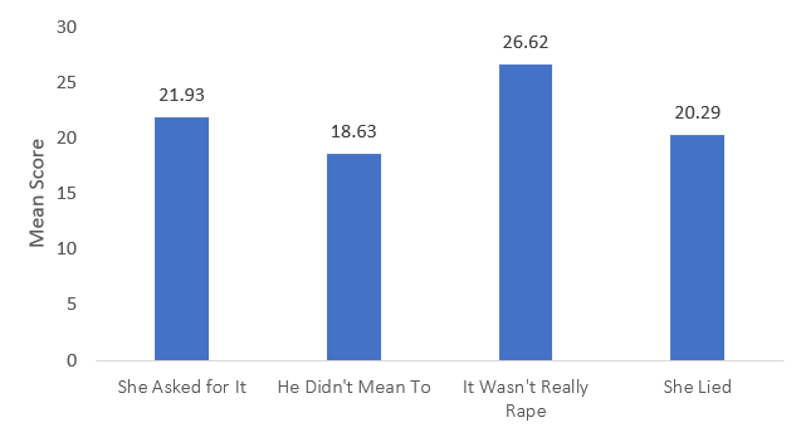
Table 2 presented the four IRMA subscale mean scores. The overall mean rape myth acceptance (RMA) score was 21.87 (SD = 3.86), which corresponds to a relatively strong level of endorsement. Most strongly endorsed was “It Wasn’t Really Rape” (M = 26.62, SD = 4.75), which suggested that many students question the existence of rape when there is not overt force. “She Asked for It” (M = 21.93, SD = 3.65) reflected strong victim-blaming attitudes, with students citing women behaviour or dress as causal. “She Lied” (M = 20.29, SD = 3.64) reflected disbelief in survivors’ credibility, with implications for under-reporting. “He Didn’t Mean To” (M = 18.63, SD = 3.41) was the least endorsed but still reflected high tolerance of perpetrator-excusing myths. These findings are visually summarized in Figure 1, highlighting the relative distribution of rape myth acceptance across the four subscales.
Differences across Socio-Demographic
Males exhibited higher levels of RMA scores compared to females (55.9% vs 45.1% in high-acceptance group). Although males showed higher levels of rape myth acceptance than females, this difference did not reach statistical significance (χ² = 3.44, p = 0.064). Age was not significantly related to RMA (χ² = 0.25, p = 0.621). Participants aged 18–19 years and those aged ≥20 years reported similar levels of myth acceptance (49% vs 52.1%). By class, students in Upper Sixth had the highest percentage of high RMA (58%), followed by Lower Sixth (50.8%) and Form 5 (44.9%), but the differences were not significant (χ² = 3.77, p = 0.152).
Predictor of Rape Myth Acceptance
In exploratory logistic regression, male students had higher odds of rape myth acceptance (OR = 1.45, 95% CI 0.98–2.16), but this association was not statistically significant. Age and class were not significant predictors after adjustment.
Discussion
This study provides empirical evidence of a relatively strong rape myth acceptance among older adolescents and young adults enrolled in crisis-affected secondary school in Buea Municipality, Cameroon. The findings show that despite increased public sensitisation campaigns, myths about rape and victims are common among older adolescents and young adults enrolled in secondary school. For conceptual clarity, it is important to note that although participants were enrolled in secondary schools, the sample consisted predominantly of participants aged 18–22 years, rather than minors.
The most robust support for the “It Wasn’t Really Rape” subscale shows that students themselves do not tend to recognize coercion, marital rape, and non-violent sexual assault as legitimate forms of rape. This is consistent with international research showing that myths downplaying rape in non-stereotypical “stranger danger” scenarios are among the most pernicious
.
In contexts where marital and intimate partner rape are less well-known, such attitudes have the potential to further impunity for perpetrators. Victim-blaming attitudes, as evidenced by the high scores on “She Asked for It” shares a resemblance with those in other African settings. In a Tanzanian community study, participants were found to routinely blame women’s dressing or behaviour as the reason for rape
.
In Nigeria and Ghana, research documented students’ prevalent perception of women as precipitating sexual assault
,.
These beliefs create a culture of silence, stigma, and underreporting in Cameroon, where rape is hugely under-documented despite being legally prohibited
.
The popularity of “She Lied” reflects widespread mistrust of survivors, which can strongly discourage reporting. Cross-national comparisons attest to a similar trend: a multi-country study (USA, Japan, India) found that students in Asian contexts were especially likely to disbelieve survivor claims
.
In Cameroon, this disbelief may be exacerbated by cultural taboos on sexuality and social pressure to preserve family honor. Whereas “He Didn’t Mean To” received the least support, the prevalence of perpetrator-excusing myths testifies to the normalisation of male sexual aggression. This mirrors McMahon’s (2010) findings in the United States
,
where these myths, although less prevalent, still affected bystander inaction. In patriarchal societies like Cameroon, such messages are reinforced by norms legitimising men’s behavior while controlling women’s.
Although males showed higher odds of rape myth acceptance than females, this association was not statistically significant; therefore, no definitive gender-based conclusion can be drawn from this sample. The direction of this non-significant association is consistent with previous studies suggesting that men may be more likely to endorse rape-supportive attitudes, although our findings do not provide definitive evidence of a gender-based difference
.
However, contradictory evidence from Tanzania, where women also accepted myths, suggests that contextual factors such as economic vulnerability and socialisation shape these attitudes
.
The absence of variation by age or class level may indicate that rape myths are widely internalised within this population. However, given the cross-sectional nature of the data, these findings should be interpreted cautiously. Among adolescent groups, indicating profound cultural entrenchment, it also indicates that schooling alone is not a sufficient counter to harmful beliefs without targeted intervention. Authors should consider the age composition of the participants while interpreting this result. Although participants were secondary school students, with the current crisis in the region, we had older adolescents and young adults aged 18–22 years. As such, the results reflect rape myth acceptance among older secondary school students, rather than younger adolescents.
This study is one of the earliest in Cameroon to empirically quantify rape myth acceptance among older adolescents and young adults on an internationally validated scale. Its findings have implications for the urgent need to tackle rape myths at the secondary school level, particularly in crisis-prone settings where GBV is increasing. Contrary to existing studies focusing on university populations, this study suggests that problematic beliefs consolidate earlier, necessitating preventive education interventions before adulthood.
Conclusions
This study provides informative empirical data on the prevalence of rape myth acceptance among students enrolled in crisis-affected secondary schools in Buea, and evidence that relatively strong acceptance is prevalent. The strong support for myths questioning the legitimacy of some rapes is a very interesting result. Though gender had been trending towards males being more accepted at higher levels, as with much of the research, other demographic characteristics like class level and age group were not shown to significantly correlate with myth acceptance in this population. These results highlight the necessity for school-based interventions that are targeted to counter specific myths and enhance correct knowledge of sexual violence among older adolescents and young adults, with a possible focus on action to counter prevalent myths and normative attitudes towards gender that serve to maintain them.
Limitations and Future Directions
This study has a few limitations. Being a cross-sectional survey, causality cannot be established, and attitudes were assessed at a single point in time. Self-reported data may also have been influenced by social desirability bias. Future longitudinal or qualitative studies may want to look at how these beliefs are formed and reinforced. Furthermore, taking the research to other regions of Cameroon may capture national trends. In addition, the purposive selection of the schools at the entry points of Buea Municipality may limit the generalization of findings to all secondary school students in the municipality. In particular, students attending schools in more secure central areas of the town may hold different attitudes toward rape myths. Findings should therefore be interpreted as representative of students enrolled in crisis-affected secondary schools, rather than the entire municipality. Subgroups were exploratory and no corrections for multiple comparisons were applied, meaning that statistically significant associations should be interpreted cautiously. The subscale reliability coefficients were relatively low (α < 0.60), which may introduce measurement error at the domain level and should be interpreted with caution. However, the overall scale demonstrated acceptable internal consistency (α = 0.75), supporting its use as a global measure in this population. Finally, this analysis did not explicitly adjust for clustering within classes.
Policy and Practice Implications
This includes curriculum reform through the addition of consent education and gender-equity modules to secondary school curricula, alongside community engagement by mobilising parents, teachers, and religious leaders to counteract harmful norms. It also involves youth empowerment programs, particularly peer-led initiatives that dispel myths and promote survivor-supportive cultures, as well as efforts to raise adolescents’ awareness of rape laws and survivors’ rights in Cameroon.
Author’s Contributions
The study was conceptualized by ADT and RAT, who also led the design of the methodology. ADT was responsible for the development of the research instrument, while NWA conducted the data analysis. The manuscript underwent critical revision by ANM, NK, and AC.
Availability of Supporting Data
The dataset generated and analyzed during the study is not publicly available due to the sensitive nature of the topic. However, data may be available from the corresponding author on reasonable request.
Conflict of Interest
The authors declare that they have no competing interests related to this study.
Ethical Approval
Ethical approval was obtained from the Regional Ethics Committee for Human Health Research for the Southwest Region (Ref: No. 478/CRERSH/SW/C/05/2025).
Davis JP, Pedersen ER, Rodriguez A, et al. Do Recent Experiences of Sexual Violence and Co-Occurring Depression and Anxiety Symptoms Predict Poorer Functioning One Year Later During the Transition to Young Adulthood? Journal of Interpersonal Violence 2022; 37: 804–834. https://doi.org/10.1177/0886260520913648
World Health Organization (WHO). (2021). Violence against women prevalence estimates, 2018: Global, regional and national prevalence estimates for intimate partner violence against women and global and regional prevalence estimates for non-partner sexual violence. World Health Organization. https://www.who.int/publications/i/item/9789240026681
Abeid M, Muganyizi P, Massawe S, et al. Knowledge and attitude towards rape and child sexual abuse – a community-based cross-sectional study in Rural Tanzania. BMC Public Health 2015; 15: 428. https://doi.org/10.1186/s12889-015-1757-7
Anderson GD, Overby R. The Impact of Rape Myths and Current Events on the Well-Being of Sexual Violence Survivors. Violence Against Women 2021; 27: 1379–1401. https://doi.org/10.1177/1077801220937782
Suarez E, Gadalla TM. Stop Blaming the Victim: A Meta-Analysis on Rape Myths. Journal of Interpersonal Violence 2010; 25: 2010–2035.
McMahon S. Rape Myth Beliefs and Bystander Attitudes Among Incoming College Students. Journal of American College Health 2010; 59: 3–11.
Stephens T, Kamimura A, Yamawaki N, et al. Rape Myth Acceptance Among College Students in the United States, Japan, and India. Sage Open 2016; 6: 2158244016675015.
Opekitan AT, Ogunsemi O, Osalusi B, et al. Perception of victims of rape and perception of gender social roles among college students in Southwest Nigeria: validation of a 5-item gender scale. International Journal Adolescents Medicine and Health 2019; 31: 20170056. https://doi.org/10.1515/ijamh-2017-0056
Malinen K, VanTassel B, Kennedy K, et al. Victimhood and Blame Dialectics in Culturally Diverse Male Students’ Discussions About Sexual Assault Policies. Journal Men’s Studies 2023; 31: 371–395. https://doi.org/10.1177/10608265231182100
Maigemu AY, Adamu RS. Knowledge and Awareness of Rape Myths among the People of Gusau Town in Zamfara State, Nigeria: A Medical Sociology Perspectives. International Journal of Social Science Research and Review 2025; 8: 30–37. http://doi.org/10.47814/ijssrr.v8i2.2464
Table 1: Socio-Demographic Characteristics of Participants
Table 3: Association of Socio-Demographic Factors and Level of Rape Myth Acceptance
Variable
Category
n
Low (%)
High (%)
χ²
p-value
Age group
18–19 years
204
104 (51.0)
100 (49.0)
0.245
0.621
≥20 years
96
46 (47.9)
50 (52.1)
Gender
Male
136
60 (44.1)
76 (55.9)
3.443
0.064
Female
164
90 (54.9)
74 (45.1)
Class
Form 5
147
81 (55.1)
66 (44.9)
3.773
0.152
Lower Sixth
65
32 (49.2)
33 (50.8)
Upper Sixth
88
37 (42.0)
51 (58.0)
Table 4: Logistic Regression Analysis of Predictors of Rape Myth Acceptance
Variable
Category
OR (95% CI)
p-value
Gender
Male vs Female
1.45 (0.98–2.16)
0.064
About the Authors
Arole Darwin Touko
Affiliation: Department of Public Health and Hygiene, University of Buea, Buea, Southwest, Cameroon; Hope In Pink Foundation, Buea, Southwest, Cameroon
Affiliation: Department of Public Health and Hygiene, University of Buea, Buea, Southwest, Cameroon; Hope In Pink Foundation, Buea, Southwest, Cameroon
Adille Ngabe MacBrine
Affiliation: Department of Public Health and Hygiene, University of Buea, Buea, Southwest, Cameroon; Hope In Pink Foundation, Buea, Southwest, Cameroon
Ngu Winston Asanga
Affiliation: Department of Public Health and Hygiene, University of Buea, Buea, Southwest, Cameroon; Hope In Pink Foundation, Buea, Southwest, Cameroon
Nakinti Nofuru
Affiliation: Gender, Discourse, and Language Studies, Cameroon
Adjimi Caroline
Affiliation: London School of Hygiene and Tropical Medicine, London, United Kingdom
Corresponding Author
Arole Darwin Touko
Department of Public Health and Hygiene, University of Buea, Buea, Southwest, Cameroon
Email: toukoarole@gmail.com
Figures & Tables
Figure 1: Mean rape myth acceptance score across IRMA subscales
Visual summary of the relative distribution of rape myth acceptance across the four Illinois Rape Myth Acceptance (IRMA) subscales: She Asked for It, He Didn’t Mean To, It Wasn’t Really Rape, and She Lied.
×
Figure 1: Mean rape myth acceptance score across IRMA subscales
Visual summary of the relative distribution of rape myth acceptance across the four Illinois Rape Myth Acceptance (IRMA) subscales.